According to current estimates, software revenue from the use of generative AI will increase from $40 billion in 2022 to approximately $1.3 trillion in the next 10 years (Source: Bloomberg Intelligence). A concrete example is the AI assistant “Github Copilot,” which supports software developers in their daily work. A study measured productivity gains and found that a developer using this technology works on average 55% more efficiently. Another example is Microsoft 365 Copilot, released in November, which can create presentations, write emails, and summarize meetings.
The landscape of generative AI has become so extensive that it is challenging for companies to find their entry point into this essential technological domain. Therefore, we have developed the GenAI Maturity Model, which, in addition to self-assessment, provides a concrete roadmap.
GenAI Maturity Model
The GenAI Maturity Model comprises four consecutive stages – Junior, Senior, Principals, and Partners – which refer to the maturity level of companies in the field of generative AI.
JUNIORS
Entry into the world of GenAI begins with the use of available tools like ChatGPT or Bard. This stage represents a solid starting point for identifying optimization potentials. However, the full scope is only provided through paid versions – such as GPT 4. It is imperative to note that the setting Chat history & training must be deactivated in a business context. While chats will then no longer be saved, the manufacturer OpenAI would otherwise be officially allowed to use chat histories for model training. For reasons of data protection and information security within the company, this setting should therefore be deactivated. Furthermore, the barrier between artificial intelligence and business-relevant applications/data restricts its use, as all data must be provided manually.
The creation of company-related user requests – such as “Write an email to the new lead max.mustermann@firma.de and inform him about our new product XYZ. Below you will find the information about our product XYZ…” – requires overcoming such hurdles, which is the subject of our next stage Senior.
SENIORS
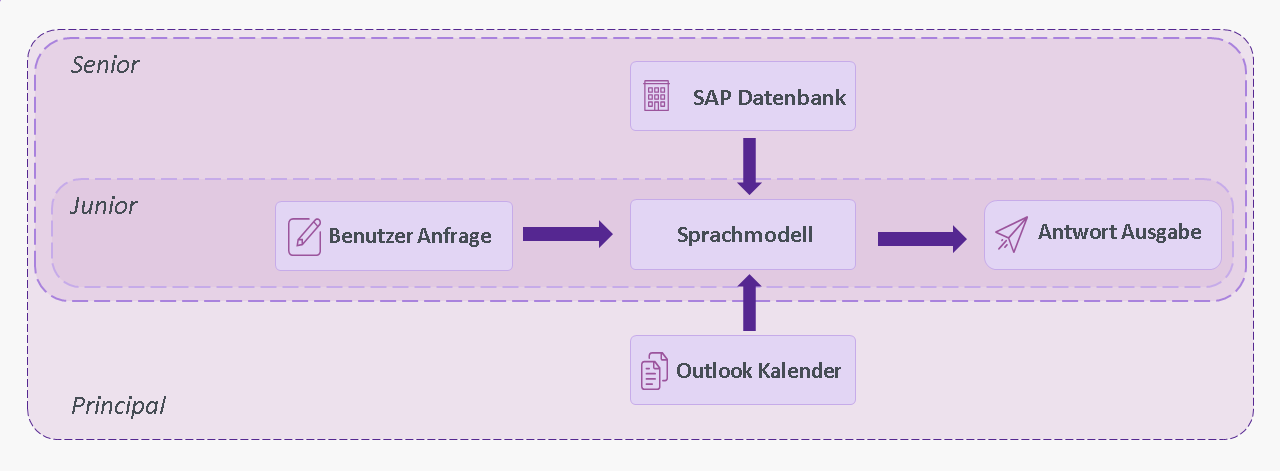
A Senior utilizes the integration of GenAI tools into standard programs such as Microsoft 365 Copilot, Salesforce, and Atlassian Intelligence. This enables a simple, cost-efficient, and powerful application that can access isolated data pools – such as an SAP database – of a company. Here is an example request:
“Write an email to the new lead max.mustermann@firma.de and inform him about our new product XYZ (see SAP)”
However, communication between different applications does not exist, and not every data pool is available via the GenAI application. For company-specific use, it is advisable to undertake further specializations to fully exploit the potential of GenAI within the company and consciously leverage generative AI as a competitive advantage. This leads us to the next stage Principals.
PRINCIPALS
Instead of merely following the broad mass of Seniors, Principals go a decisive step further. By developing proprietary GenAI tools, for example, based on language models via Azure, OpenAI, Aleph Alpha, and Pinecone, tailored solutions for specific use cases can be realized. Through cross-system data integration – such as the additional integration of the Outlook calendar, network drives, or any other data pools – the enormous potential of generative AI can be leveraged. An example request would be:
“Write an email to the new lead max.mustermann@firma.de and inform him about our new product XYZ (see SAP), attach my availability so we can schedule a call directly (Outlook).”
In summary, a schematic overview of the stages:
PARTNERS
To go one step further beyond the Principal level, companies at the Partner level develop their own language models. While this sounds desirable, it is often not necessary and primarily left to large research teams. Although the direct integration of knowledge into a model’s training can achieve the highest degree of specialization and adaptability, this is also associated with immense time and cost. In most cases, using an existing language model at the Principal level already optimally covers most of a company’s needs.
Process
GenAI tools not only enable the automation of workflows but also simplify information retrieval and communication, which in turn shortens decision-making processes. This ongoing trend will continue to intensify in the coming years, offering companies the opportunity to gain a significant competitive advantage.
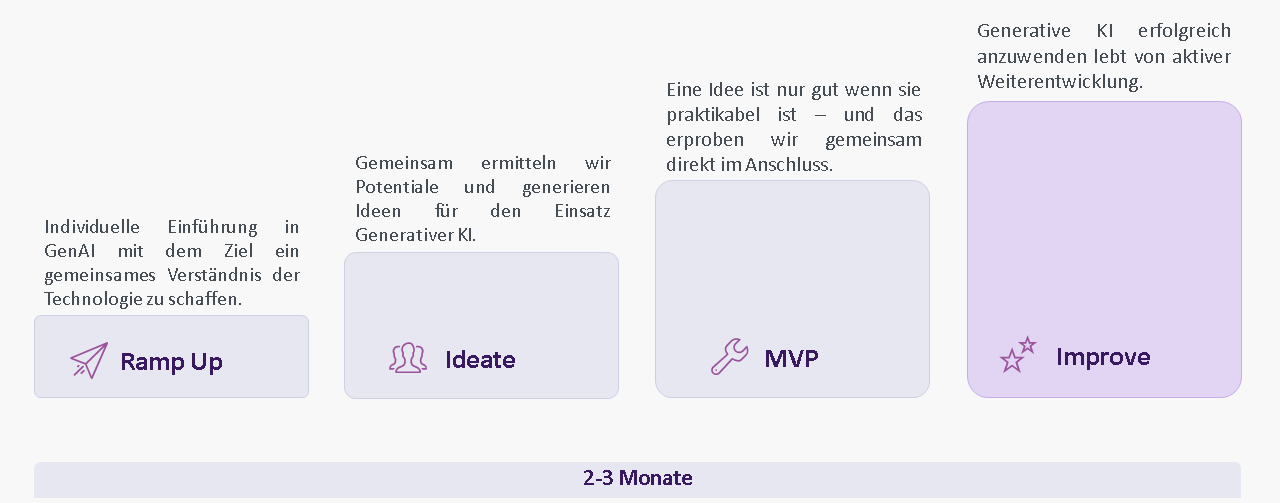
digatus.ai accompanies your company into a Generative AI-driven future with an agile process approach.