By definition, a project is a temporary endeavor aimed at creating a unique product or service. The project manager’s task is to plan, organize, and control these projects. There are fundamental differences in the nature of projects. While projects in manufacturing or product development are often characterized by very stringent planning, those in management consulting tend to be somewhat less structured.
The need for effective project management becomes evident when considering that 30% of projects still fail to meet their original objectives, and 40% exceed their budget. IT projects perform particularly poorly. The average IT project runs 27% over budget. It is exceptionally critical that every sixth IT project even develops into a “black swan,” being completed 200% more expensively and 70% slower than planned.
A positive development is that the focus on project management appears to be yielding results. Success rates have steadily improved over recent years. A key reason for this trend is the convergence of insights from theory (research) and practice. The findings from research and practice are summarized in a standard by organizations such as the Project Management Institute (PMI). They provide a foundation and guide for effective project management.
Regarding the question of what a project manager should be capable of, these standards have long moved beyond focusing solely on purely technical or methodological competencies. Instead, they divide a project manager’s skills into three categories. According to the Project Management Body of Knowledge (PMBOK), effective project managers require not only technical project management expertise but also leadership competencies and knowledge in strategic and business management. But what do these points actually mean, and how important are they?
Technical Project Management
Technical project management refers to the knowledge, skills, and behaviors required to perform the role of a project manager. They are the foundation a project manager must master to be successful. In our increasingly complex and competitive world, technical project management is the foundation, but no more than that. It is becoming increasingly important for project managers to possess various other qualities.
Leadership
One of these qualities is leadership. It describes the ability to lead, motivate, and guide. This encompasses various soft skills, such as negotiation skills, communication, problem-solving competence, and other interpersonal skills. This development is hardly surprising when considering that project management means more than just numbers, tables, and diagrams. Therefore, in our internal survey, our team also classified this quality as the most important success criterion for a project manager.
Strategy and Business Management
The last, but no less important, quality is strategy and business management. A good project manager must not only master the fundamentals of project management and be a leader, but also possess a strong understanding of the strategy and business model of the project or client. They are able to classify events within the project accordingly and keep the big picture in mind. This knowledge or ability is often referred to as domain expertise and is the third building block of a good project manager.
Internal Survey
Since we frequently work on a project basis in our consulting practice, we surveyed our employees on the topic “What makes a good project manager?” to compare theoretical insights with practical experience.
Based on the question, three main categories emerged: (Self-)Management Skills, Methodological Competence, and Leadership Qualities. The following table shows which specific skills, in our opinion, belong to the respective overarching categories.
| Management | Leadership | Methodological Competence |
| Structured Work | Team Leadership | Expert Knowledge (methodological and business-related) |
| Time Management | Empathy | |
| Organization | People Skills | |
| Resilience | Self-confidence | |
| Goal-oriented Approach | Psychological Expertise | |
| Enthusiasm | Stakeholder Relationships | |
| Communication | ||
| Foresight / Overview | ||
| Courage | ||
| Results-oriented Work |
According to the survey results, management skills are indispensable for a project manager to be successful and recognized. Leadership competencies should not be neglected. Especially in complex projects, project managers must keep a cool head, maintain relationships with stakeholders, and keep the project team on track to achieve the common goal. The area of methodological competence was mentioned least frequently in our survey. From our perspective, however, methodological and technical/business competencies form the basis for a good project manager. Comparing these with the results of a study (The project manager core competencies to project success – International Journal of Managing Projects in Business) clearly shows that our survey contributes to confirming the theory.
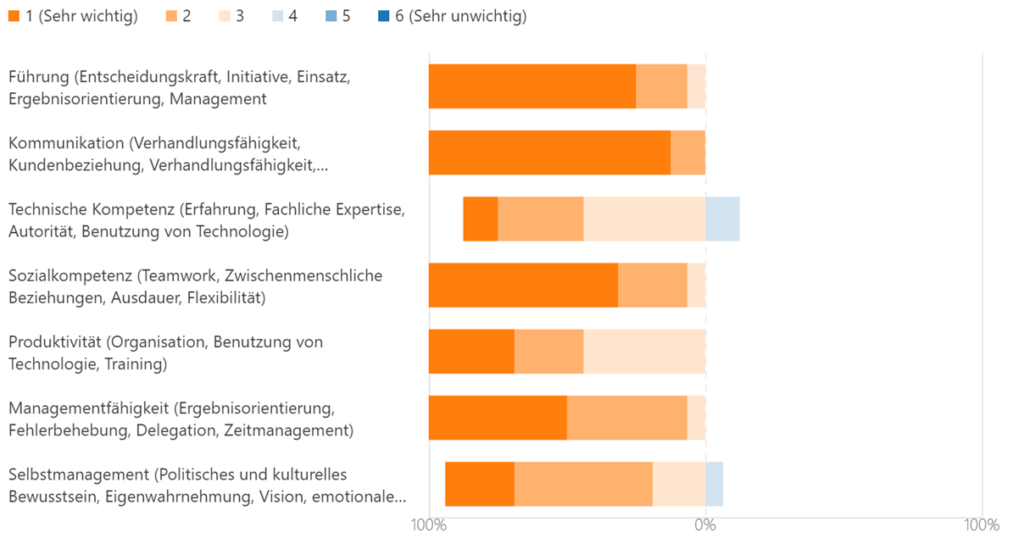
The project manager core competencies to project success – International Journal of Managing Projects in Business
Today, the skill set of an effective and successful project manager is naturally supported by the right technologies. As a Microsoft Partner, we rely on well-known applications such as MS Teams, Planner, and Projects, among others. However, other applications like Teamwork and Jira/Confluence are also used to manage projects in a structured and successful way. The benefits are clear. Collaborative work on documents and files prevents unstructured exchanges of various work statuses, essentially creating a single source of truth. Furthermore, transparency is increased, unnecessary email traffic is avoided, and every team member is always up-to-date.
Conclusion
Expert knowledge and methodological competence naturally form the basis for successfully managing projects in a business environment. However, a good project manager is primarily characterized by management skills and leadership qualities. These include a certain composure and a degree of self-confidence. This implies that a good project manager has already gained extensive experience and consequently brings routine to the role. Effective communication rounds out their profile. Naturally, this comprehensive skill set is not simply innate. Therefore, we continuously work with all employees to improve daily through internal training, further education, and certifications.