The origins of Design Thinking lie in the 1960s, when designers increasingly worked with other departments and professional disciplines, such as engineers, salespeople, or scientists. Due to different views, approaches, and training, communication problems often arose. To facilitate interdisciplinary collaboration and improve team results, the Design Thinking process was developed. The goal was to find a common starting point to generate knowledge and create new solutions based on it.
The Design Thinking approach adopts the creative, experimental, and flexible working method of designers to describe a team-based and interdisciplinary process. It uses a toolbox of various creative methods. Design Thinking is a highly user-oriented way to solve particularly complex problems. To get to the bottom of even the hidden needs of users, the team should be as interdisciplinary as possible. This should involve all persons who have touchpoints with the problem and the users.
Fundamental Principles in Design Thinking
In implementation, the Design Thinking approach is guided by these four fundamental principles:
- User as Starting Point
- Team
- Process
- Creative Environment
User as Starting Point
From the beginning, the user is the focus of every Design Thinker. Due to the complexity of the problem, it often happens that the actual underlying problem is not completely clear at the start. Therefore, it is essential to address the needs of the user group and create real added value for them. The sought-after innovation arises at the intersection of needs (a benefit must be created), feasibility (it must be technologically implementable), and business (an ROI is achieved).
Especially in IT, the focus is shifting more and more from purely cost- and technology-driven factors to user needs. Requirements now come increasingly from the business, and solutions are no longer simply presented or dictated to users. The technologies used in their various forms should support the creativity of users and be particularly user-friendly in handling.
Team
The team determines the output. When composing the team, it’s important to ensure that all groups of people who have anything to do with the user or the problem are represented. Interdisciplinary teams from different departments with diverse interests work more creatively on average and can better analyze problems. This is exactly what is needed in Design Thinking! Within the team, each member has the same rights; only in exceptional cases is there a decision-maker. In the case of a Design Thinking workshop regarding IT services or products, the team should not consist only of IT employees. The opinions, needs, and experiences from other business areas must also be considered in order to optimally align the later prototype accordingly.
Process
Since multidisciplinary teams are used in Design Thinking, it is all the more important to provide a clear process. Each process step contains methods that are chosen depending on the problem at hand. At digatus, we use the double diamond as a process in Design Thinking workshops to keep track of the individual phases and their respective goals. The double diamond is divided into problem and solution diamonds. It is important to distinguish between divergent and convergent thinking.
Divergent thinking means engaging with a topic or problem in an open, unsystematic, and experimental way, colloquially expressed as ‘the more, the better’. Here, methods are used that barely limit the results, e.g., qualitative interviews in the Understand phase or brainstorming in the Develop phase.
Convergent thinking describes the usual, linear, strictly rational-logical thinking. Here, one tries to process the information gained from divergent thinking, thus narrowing it down. A popular method in the Define phase is, for example, clustering, while in the Deliver phase, it’s the concept sketch.

Double Diamond in Design Thinking
Understand: Reveal needs that were not even conscious to those surveyed
Define: Develop a deep understanding of the user
Develop: Generate a multitude of ideas
Deliver: Develop a solution, create a prototype and test it
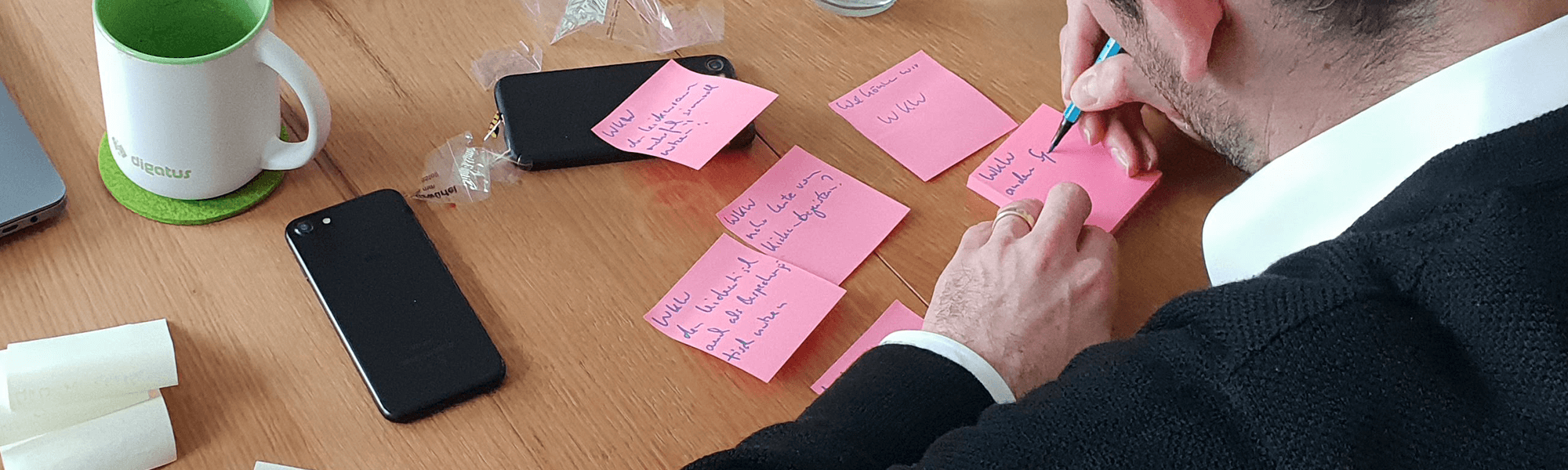
Creative Environment: A Design Thinking workshop primarily needs space to let ideas flourish. Work is done without electronic devices; in most cases, paper, post-its, and pens are sufficient to achieve good results. Time constraints should be strictly adhered to so that workshop participants don’t get lost in endless discussions.
It’s All About the Right Mindset
The mindset is what makes Design Thinking special and sets it apart from other approaches. The mindset allows the team to grow together. To ensure this succeeds, there are some basic rules to follow:
The user is always at the center, without exceptions. The end product should meet the needs, otherwise, iteration occurs.
Design Thinking encourages working actively and being guided by one’s own intuition. The hands-on mentality is considered very important.
There aren’t many strict rules in Design Thinking, but the process steps should be followed.
Design Thinking works specifically with images or drawings that should tell stories through visual storytelling. This approach promotes the creativity of workshop participants.
Ideas of team members are not criticized or questioned. One tries to build upon their ideas, like the foundation of a house.
Experimenting is a decisive criterion in Design Thinking. Be it in idea generation in the Develop phase or in prototype creation and testing in the Deliver phase.
Why We Use Design Thinking at digatus
Who doesn’t know it, seemingly endless discussions about a problem, and after an hour it turns out that the problem was interpreted differently and should be reworked accordingly in the functional teams. We often see this with clients or in our internal projects. Additionally, it happens that decisions in IT are made based on opinions or recommendations that were not sufficiently evaluated beforehand and therefore do not solve the actual problem.
Design Thinking is an intuitive way of working that is very flexible in use to structure exactly these situations. The basics and methods are quick to learn and easy to apply. The problem and the solution approach are always considered and analyzed holistically. Only in this way can a user-centered result be achieved.
In daily work in IT projects and IT consulting with clients, we also see through Design Thinking methods an effective way to understand problems faster and generate more solution approaches in less time.
Our Design Thinking method box is always at hand in our office. Innovation takes time and must be learned. It’s like learning a language, where automatisms take hold with practice and time. As a result, we have created a new meeting culture in our premises that better utilizes available time and clearly focuses on output.
Design Thinking in IT Consulting
Design Thinking has been used in product development for years. However, we see that this positive development has not yet fully arrived in our industry. Due to rapid change and necessary transformations in IT, new roles and responsibilities, previous methods, and especially processes, are reaching their limits. The increasing shift of IT responsibility towards business enabling results in IT being viewed more and more as a product or service. To evaluate a solid basis for change in these IT services, where the user is the focus, a structured approach like Design Thinking is a reliable construct.
At digatus, we primarily use Design Thinking methods and approaches in establishing strategies and visions, as well as in conceptualizing IT services.
Conclusion
Design Thinking is an important and frequently used tool for us. We are fascinated by how one can bring a pre-tested product or service to market in a short, plannable time. Especially in the IT industry, where fixed costs are low and economies of scale play a crucial role, it is essential to understand the changing needs of customers and fill the resulting gap.
We are convinced that through Design Thinking, we can support our customers faster, more effectively, but above all, with the increasingly important user acceptance.
Once applied in the company, the methods can be integrated into daily work, thus making the problem-solving process more effective. Therefore, it’s a win-win situation for the entire company.