Need for Digitalization
The need for digitalization is ubiquitous, and the nursing sector is also addressing this topic. Mobile devices such as smartphones or tablets are already in use in many facilities. Especially now, while access to nursing homes for relatives is severely restricted due to Corona, they enable important social contacts with relatives via video calls, thus bringing a touch of normality back into the daily lives of care recipients. However, widespread use is not yet a reality. Too often, a central computer, a printer, and a filing cabinet are still the status quo for daily nursing documentation. For comprehensive digitalization, the following challenges must first be considered and addressed:
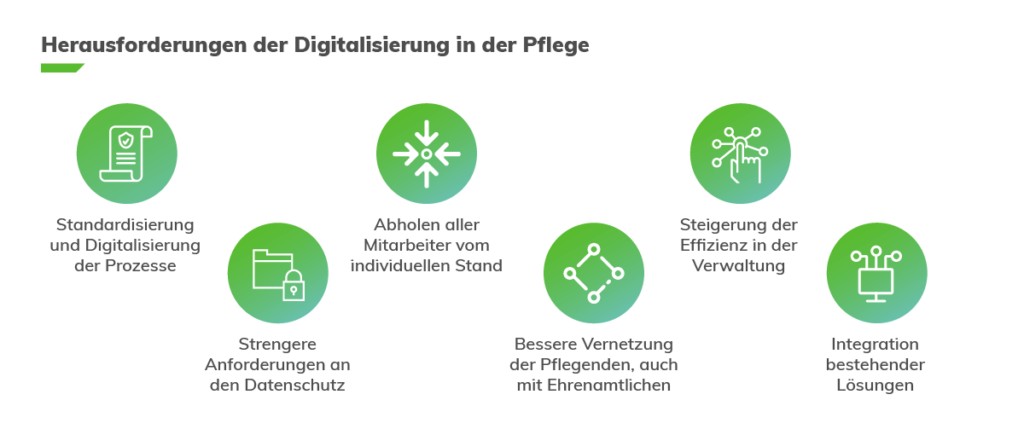
Through our industry focus with the Business Center Public Sector and NGO, we are familiar with the specific challenges of social institutions in the IT sector and are able to support them as an IT service provider on the path of progressive digitalization.
Why is Digitalization in Nursing Care Worthwhile?
At the heart of nursing care, two central groups directly affected can be easily identified: nursing staff and the recipients of care services, i.e., care recipients. When planning any technological innovation, it must be ensured that added value is created for at least one of these two groups.
For care recipients, the primary goal is to improve their quality of life, both in outpatient and inpatient care, in homes or hospitals. For example, if an intelligent floor detects a fall and help arrives without delay, if caregivers have more time for patient care due to reduced administrative effort, or because TV programs are reliably delivered to devices via fiber optics without, for instance, losing the channel list sorting.
The second target group, those employed in nursing care, should be relieved as much as possible in their daily work through technological support. Many nursing technologies already exist, such as nursing software for flexible care documentation, as well as tour or duty planning that is used on a smartphone. This saves the need to go from the office to the room, back, and possibly further to administration to document daily work.
How Can Digitalization Succeed?
At Digatus, we pursue a more holistic approach. As a member of FINSOZ e.V. (Professional Association for Information Technology in Social Economy and Social Administration e.V.), we are familiar with professional standards and current industry-specific research. Additionally, our colleague Mathias Müller provides his expertise in the FINSOZ speaker pool.
On the path to digitalization, the first step should be to create the infrastructural basis for the use of modern and future-proof technologies in daily nursing care. We advise and support clients in enabling stable technological support and bringing the necessary know-how into the nursing sector.
We have so far supported our clients, for example, through strategy projects, the creation of technological foundations such as the expansion of fiber optic or WLAN networks, the migration of users to online applications, or entire data centers. We also assist our clients with tenders and bidding processes, as well as the selection of suitable service providers and industry software, for example, for nursing documentation, the creation of duty rosters, or occupancy management.
The use of digital technologies in nursing care also entails risks that must be considered. A high proportion of personal data in daily use requires expertise in IT security and data protection to ensure legal compliance.
Another challenge is to provide all employees, regardless of their IT affinity, with access to added value and to involve them in shaping the change. For example, nursing staff can operate device- and location-independently with their user account for more flexible collaboration. Things like a centrally accessible Excel list via SharePoint, jointly managed tasks in Planner, or the nursing application on a smartphone or tablet increase mobility and transparency. This allows upcoming tasks to be coordinated and administrative work to be done on the go.
This can only be achieved through:
- Practical and well-functioning technologies. Usability is important for acceptance, especially during the transition, but also for effective support.
- An adequate infrastructure, such as the mentioned WLAN network, forms the basis for the efficient use of technologies in daily nursing care. Isolated technological innovations, such as smartphones, without proper connection to a service hotline or reliable WLAN, may hinder the willingness for further technological innovations.
- Well-considered processes, structured implementation, and coordinated service for operation
- Active Change Management and Practical Training for Staff
Outlook
Based on the technological foundations created, a sustainable change in nursing facilities can be realized in the future, and the use of AI and robotics in nursing care can also be meaningfully developed. The mentioned challenges, on a determined path of digitalization, should be considered as an opportunity for a higher quality of life for care recipients and increased attractiveness of facilities as modern employers in nursing care.