What does digitalization look like in the social sector?
In communication with clients and patients, online counseling is gaining increasing importance, and a diverse range of services already exists today, from assistance in cases of suicide risk to debt counseling and advice for pregnant women. Furthermore, digital and technological aids are increasingly being deployed. For instance, in collaboration with the German Aerospace Center, Caritas is currently testing a care robot in an elderly care home, which has been very positively received by patients so far. Within social organizations and institutions, digitalization primarily aims to first digitally capture and map existing processes, and then automate and optimize them through the implementation of digital solutions. The use of digital aids is also conceivable here to reduce employee workload and thus free up more time for direct care and support.
Catalysts for a Higher Degree of Digitalization
Digitalization also entails change. Impulses for this transformation originate from diverse sources and are influenced by many different factors. The particularly decisive drivers include:
- Market and Competition
- Cost Pressure
- Needs and Services
- Employees
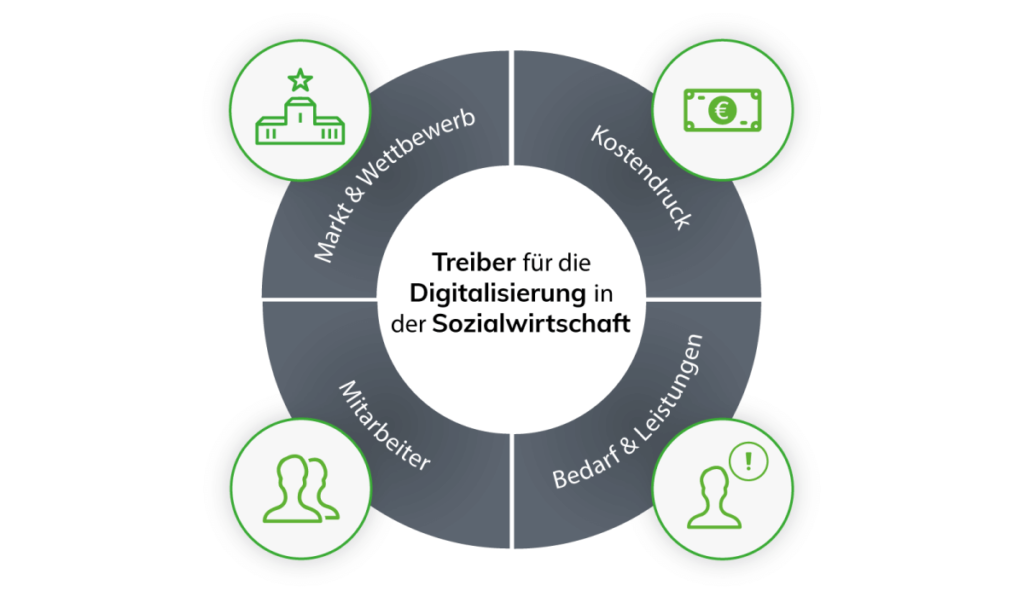
Drivers and Influencing Factors of Digitalization in the Social Welfare Sector
Market and Competition
Stable and steadily growing demand, partly due to demographic change, ensures continuous and crisis-resistant market growth. For instance, focusing solely on the care sector, the number of people requiring care in 2017 reached 3.4 million. Consequently, the number of nursing homes in Germany increased by approximately 60% between 1990 and 2017.
However, private corporations are increasingly entering the market, competing with non-profit institutions, particularly in segments such as elderly care and in the areas of schools and hospitals. They often possess more capital than established church-based, municipal, or state organizations. Furthermore, they are significantly more efficiency-oriented. The challenging situation caused by increasing privatization, for example in the care sector, was underscored by Diakonie, Caritas, and Arbeiterwohlfahrt during their last district meeting in Würzburg. They aim to enhance the attractiveness of training for nursing specialists and the nursing professions themselves.
Cost Pressure
Cost bearers, such as health insurance companies, municipalities, and federal states acting as grant providers, allow little flexibility in remuneration and demand highly detailed billing records. Furthermore, laws and other regulations result in significant administrative burdens, for example, in billing for services or managing personal data. Simultaneously, labor costs are continuously increasing. Digitalization, above all, can substantially reduce administrative overhead. This enables social enterprises to better withstand cost pressure.
Needs and Services
The social welfare sector is tasked with providing a wide array of services for highly diverse target groups, including the elderly, the sick, children, as well as refugees and asylum seekers. Moreover, public expectations for quality care and support are rising, leading to an increased emphasis on intensive communication and relationship building within the social sector. The demand for digital offerings, improved online accessibility, and the utilization of new media is also growing.
Employees
Organizations within the social welfare sector are increasingly facing the consequences of a prevailing shortage of skilled workers, which substantially increases the workload of existing employees. Further challenges stem from the relatively high proportion of staff with non-academic and migrant backgrounds. Therefore, it is crucial to reconcile diverse educational backgrounds, qualifications, languages, and cultures. Digitalization can assist in this by reducing employee overload, for instance, through training and the automation of routine administrative tasks, while also improving communication. To provide long-term and sustainable support for their employees, Caritas President Peter Neher, for example, advocates for the inclusion of digitalization for social professions in educational curricula.
Sustainable Business Transformation through Internal Change Processes
External parties, such as customers, patients, or partners, frequently serve as the initial and most pressing drivers of digitalization. Internal development, however, is often considered secondary. Yet, it is precisely these internal catalysts that foster sustainable change and support digital business transformation. To actively advance and establish this transformation process long-term, focus must be directed towards: the IT department, the individual business units, and the employees.
To continue meeting high demands in the future, the IT department is increasingly challenged to evolve. It is no longer sufficient to merely excel in infrastructure and service management. The IT department is progressively becoming an indispensable sparring partner and acts as a consultant for the business units. It must gain a deeper understanding of business processes and proactively identify, implement, and advance new solutions, such as digital collaboration opportunities.
The business units, in turn, require new methods and approaches to specifically identify and leverage the full potential of digitalization. An agile approach enables the effective validation of problems and solution strategies within a short timeframe.
Employees represent the third crucial factor in the change process. Regardless of whether they are IT experts or end-users, all require a pronounced change competency for successful implementation. Therefore, they must primarily possess a fundamental openness to change and a willingness to actively shape this transformation.